

A series following Biblical persons who were displaced sojourners along the wandering way. Preparing the way for Advent.
Where Ancient Perspective and Modern Sensibilities Create a New Horizon
When we step into the pages of Scripture, ancient myths, or poetry from centuries past, it’s easy to forget that these works were written by people who inhabited a world profoundly different from our own. Every author wrote from a particular time, place, culture, and way of seeing reality. We, in turn, approach their words as twenty-first-century, post-Enlightenment readers shaped by modern science, technology, individualism, and conveniences unimaginable to the ancient world—electric cars, air conditioning, Wi-Fi, and instant access to information through the devices we carry in our pockets. We cannot help but bring ourselves to the text; our experiences and assumptions inevitably shape the way we read. Yet faithful reading requires the humility to recognize that our worldview is not theirs. Before asking what a text means to us, we must first seek to understand what it meant within the historical, cultural, and spiritual world from which it emerged.
We call this a “horizon,” and there are three forms we can consider when engaging with the mystics.
Horizon of expectation: the original social norms, culture, and beliefs that the writer of the past weaves into his or her story and experience.
The reader’s horizon: the biases, language, and understanding we as a reader bring to the text that shapes how we interpret and apply the given story to our lives in the present.
Fusion of Horizons: the bridge we, the reader, build with the past that forms a shared understanding of a historical text.
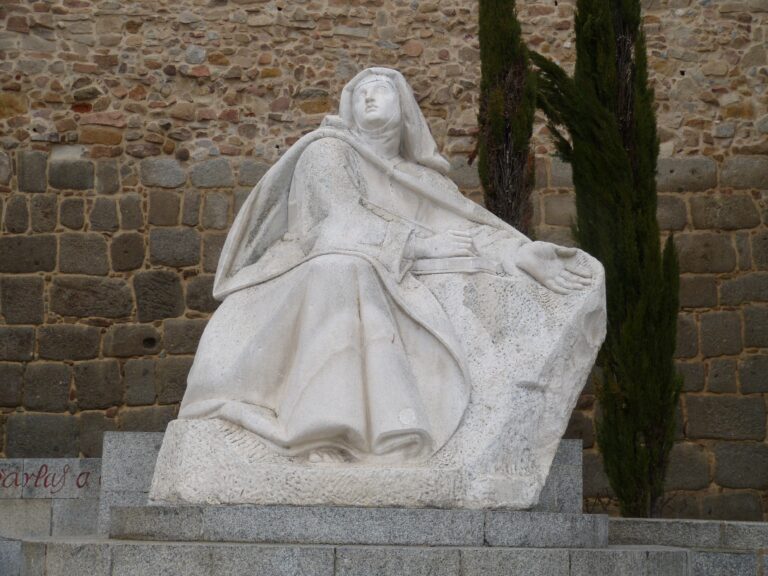
Reading with St. Teresa of Avila, 16th Century Spain
Recently, in reading excerpts of St. Teresa of Avila’s Interior Castle, she reminded me that her understanding and relationship with God, Scripture, and even prayer come from a very different horizon. I need to cautiously come to an appreciation of where her and my understanding can fuse in the middle, and it began with the following text.
Here Teresa is offering a bit of teaching to her sisters about the mysterious ways in which God offers revelation through prayer and Scripture.
“By means of the ladder Jacob must have understood other secrets that he didn’t know how to explain, for by seeing just a ladder on which angels descended and ascended he would not have understood such great mysteries if there had not been deeper interior enlightenment. I don’t know if I’m guessing right in what I say, for although I have heard this story about Jacob, I don’t know if I am remembering it correctly.” (Interior Castle, pp. 380-381)
At first reading, I laughed. It seemed comical to me that in the previous paragraph she confidently wrote to her sisters how they ought to approach discerning intellectual visions, and in the next breath is second-guessing her knowledge of God’s word. It seemed she’s not quite sure she’s got the Scripture text right. What happened to her confidence? Then I remembered, this type of “cushioned” writing is not uncommon among women mystics who wrote their revelations, teachings, or impressions on prayer, Spirit, and faith.
So, what could Teresa have meant by ‘not remembering’?
I will preface that she did admit that understanding the mystery of this nature is no easy task, and the intellectual understanding of a vision may never come. So she uses Jacob’s story to explain the nuance of discerning visions or awarenesses from God. But why does she feel so befuddled by the story?
In texts like this, we, the reader, can easily bring in assumptions from our horizon. If it were us, we’d have the Bible right in front of us, a full English translation and perhaps a commentary. Male or female, we’d confidently have read this passage many times within our Christian lives. We could not second-guess our retelling of it, even if we did jumble up some bits. Particularly, if you are male (this may be true for some women too), you’ve likely preached a sermon on the text and never batted an eye at how you presented it or in what context you shared it. So we could easily assume Teresa must not be that bright after all and be turned off from her writings.
Teresa, however, existed within a vastly different horizon.
A couple of factors to note would be…
It was not common, or allowed, for a female to teach or write about Scripture in the 16th century. Many mystic women who recorded their writings used what I call “cushion” language that made them appear to be “playing dumb.” This was actually an act of protection and brilliance because it afforded them an out from heresy claims. As a woman, it was assumed she would likely get theological or Biblical things wrong, and this type of cushioned writing projected her as having inferiority and humility.
It could also be a factual statement. She may very well have forgotten the exact understanding of the text. Teresa likely only ever encountered the text through spoken word in Latin during a homily at Mass. Her heart language was Spanish. She may have been recalling it from pure memory and then translating it into Spanish, a feat for any one of us.
Her writings would have been supervised by a spiritual director or ordained clergy, both male, to ensure against false teaching or heresy. In fact, most of her writings came to be because these men encouraged her to write. At that time, if a woman wrote freely about spiritual things, it often did not end well. Beguine mystic Marguerite Porete was burned at the stake in 1310 as a heretic for refusing to recant her writings on the spiritual path and union with God. Her works and words would have been known by Teresa as well as her friend and director, St. John of the Cross. The risk of writing could be catastrophic.
Bridging Our Horizons
I hope the idea of horizons is becoming clearer.
When meeting the mystics, we must widen our horizon before we can bridge the two. The modern Church and Christian world is a vastly different landscape than that of the mystics. Therefore, like the Bible (not equivalent to it), the mystics’ writings can be relevant to our present lives and do translate. When their context and horizon are illuminated, their works enrich our understanding and the application of it to our own lives. Through a lens of appreciation and humility, we can engage with their struggles and obstacles and relate to their humanity and spiritual insights.
WHAT TERESA IS REVEALING TO US
Teresa reminded me that she lived in a fixed point in history that affected her time, understanding, faith, gendered body, and place. Her life implications influence how we approach her words, her visions, her understanding of the Church, faith, prayer, ministry, and life. She was a real human, facing realities that are foreign to us, yet applicable across space and time. Her context illuminates and puts our lives into a fresh perspective.
We take for granted that in our present age, we are long past the Reformation. We’ve had God’s written word in the palm of our hands in a language we understand for centuries now. Women can read the words without supervision. Both men and women preach and teach from the Bible relatively freely. The Christian world has evolved.
If you delve into the teachings of the mystics, you will often hear the words ecstatic and heretic thrown about. There will be more on that. So you see, growing an appreciation for contextual horizons is important when approaching ancient writings. It is a practice of discernment that is a value of every mystic past and present. What was once heresy may not be today. Even Martin Luther was deemed a heretic at one point in history.
Saints and mystics understood their surroundings, practiced humility, devotion to God first, valued Scripture and prayer, and loved the Church. For many, taking holy orders by becoming a nun, monk, or anchorite provided supervision, guidance, and sometimes protection within the Church.
Today, St. Teresa of Avila, along with St. Catherine of Siena, both known as mystics, were the first sainted women made Doctors of the Church in 1970. Teresa was specifically recognized for her writings on the spirituality of prayer and theology. There is still much we can glean from her today if we are ready to fuse horizon lines.
Fellow Wanderer,
Over the years God’s been moving in my heart to write a book exploring the mystics and how they accompanied me through difficult seasons of life and faith. This post, along with many more to come, will be “tastes” of meanderings and research as I write my book. I’d love for you to journey with me in this writing season. So please consider subscribing to my newsletter (WayPoints) where I will link updates on the book and upcoming retreat offerings. Or if you just want to receive the posts, subscribe to my Substack: Click here.
Thank you for your support. Elizabeth
Recent Posts

This is part one of the pilgrim series focusing on Jesus' life as a wanderer. It is in preparation of my upcoming Advent Prayer Guide coming out this month!!

Pilgrim Series: Part 2--Jacob A series following a Biblical persons who were displaced sojourners along the wandering way.